

In motorsport, especially endurance racing, safety is one of the biggest factors that shape a race. Over six, twelve or twenty-four hours, accidents happen, cars break down, debris ends up on the track, and marshals and rescue crews need to get to work.
Race Control has several ways to neutralise the race so that can happen safely. The three most common are Code 60, Full Course Yellow (FCY) and Safety Car (SC). They all aim to protect people and cars, but they work differently and have different effects on the race.
Understanding those differences helps explain why a neutralisation can change strategy, close gaps, or even decide a result.
1. Code 60: 60 km/h for everyone
Code 60 is a common neutralisation in endurance racing. It is shown by a purple flag with a white circle containing the number 60.
Every car on track must drop to a maximum of 60 km/h. Drivers slow down and circulate under controlled conditions while the problem is dealt with.
According to FIA Appendix H, the signal means a single 60 km/h speed limit for the whole circuit.
In the Michelin 24H Series, run by Creventic, there are a few extra details:
- Marshals posts and light panels show the purple signal at the same time.
- A countdown is shown on the timing systems and car displays.
- Once the countdown ends, everyone must run at no more than 60 km/h.
- Overtaking is banned except when Race Control specifically allows it.
- Pit entry and exit stay open.
- Laps completed under Code 60 still count.
One of the key points is that no safety car is needed. Cars keep their relative positions and simply respect the speed limit.

What about refuelling under Code 60?
In the 24H Series, refuelling is allowed during a Code 60, but with strict limits.
Under the 2026 sporting regulations, if a full refuelling stop happens entirely during a Code 60, the maximum amount is generally 25 % of the car’s Balance of Performance refuelling capacity. That stop can only be done once per Code 60. If the neutralisation lasts more than an hour, one stop is allowed per hour under the same rules.
Teams therefore have to decide whether to use the Code 60 for fuel or wait for green-flag running.
2. Full Course Yellow (FCY): speed limit across the whole track
Full Course Yellow is used in several championships. Unlike a normal yellow flag that only covers one sector, FCY applies a speed restriction to the entire circuit.
It is signalled by a yellow flag and a board showing “FCY”. Drivers must slow down and follow Race Control’s instructions.
Typical features include:
- The speed limit covers the whole track.
- Overtaking is restricted according to the procedure and the series rules.
- No safety car is required.
- Cars are not bunched up behind a safety vehicle.
- Marshals can work while the race is neutralised.
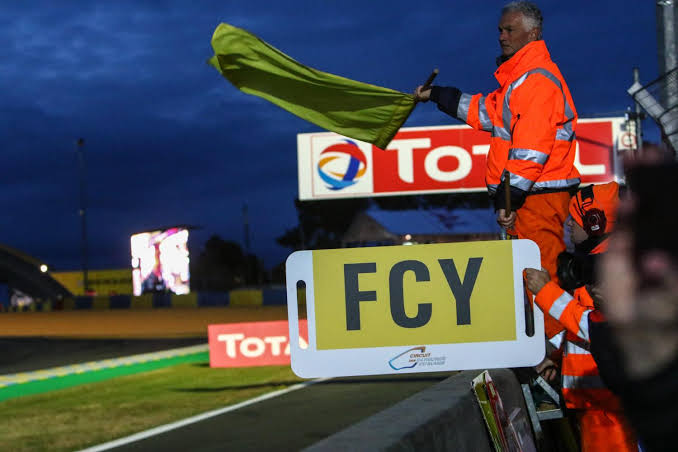
Is the FCY limit always 80 km/h?
No. This is a common misunderstanding.
FIA Appendix H describes the FCY signal but does not set a universal 80 km/h limit. The exact speed and conditions are defined in each championship’s sporting regulations.
So an FCY in the WEC is not necessarily the same as one in GT World Challenge, the European Le Mans Series or any other series.
The main goal is the same: slow everyone down so marshals can work safely without having to bunch the field behind a Safety Car.
3. Safety Car: the field bunches up
The Safety Car is the procedure most fans recognise.
Race Control sends a safety vehicle out onto the track. Drivers must slow down, form a line behind it and follow the officials instructions.
Unlike Code 60 and FCY, the Safety Car often brings the field together, wiping out the gaps that existed before the neutralisation.
Main characteristics:
- A safety vehicle joins the circuit.
- Cars must follow it in order.
- Overtaking is generally banned except for specific exceptions in the rules.
- The field often ends up tightly packed behind the Safety Car.
- The race restarts when Race Control decides conditions are safe.
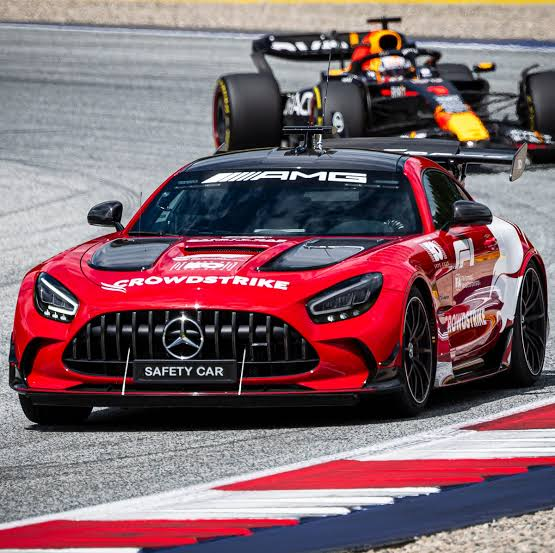
Why can a Safety Car change a race so much?
Imagine a team has built a 40-second lead after several hours of clean running. If a Safety Car comes out and both cars end up nose-to-tail behind it, most of that advantage disappears in a few minutes.
A team that has earned its gap through strategy, consistent driving and efficient stops can lose it quickly. At the same time, a car that was losing time can suddenly find itself back in the fight.
In endurance races, where gaps after many hours can still be small, a Safety Car period is often one of the most important moments of the event.
4. Side-by-side comparison
| Feature | Code 60 | FCY | Safety Car |
|---|---|---|---|
| Signalling | Purple flag with 60 | Yellow flag + FCY board | SC + yellow flags |
| Speed | 60 km/h | Defined by series regulations | Controlled by the procedure |
| Safety vehicle | Not needed | Not needed | Yes |
| Field bunched up | No | No | Usually yes |
| Overtaking | Banned except when authorised | Restricted by series rules | Generally banned |
| Strategic impact | Gaps stay roughly the same | Gaps stay roughly the same | Can close gaps significantly |
Exact rules can vary from one championship to another.
5. How the Michelin 24H Series uses these procedures
The Michelin 24H Series is a clear example of Code 60 in action.
In August 2023 Creventic announced that from 2024 it would stop using regular Safety Car periods and switch to Code 60 as its main neutralisation tool. The change was tested at the 2023 Michelin 6H Abu Dhabi and received positive feedback from teams and fans.
The organisation wanted more strategic flexibility and to avoid neutralisations that artificially closed gaps.
Further tweaks came in 2025:
- A countdown was added before Code 60 starts.
- The 60 km/h limit stayed.
- Refuelling restrictions were adjusted.
- Clearer rules were set for fuel stops during neutralisations.
The 2026 sporting regulations keep Code 60 as the primary tool.
Does that mean the 24H Series never uses a Safety Car?
No. Although regular Safety Car periods were dropped in 2024, the 2026 regulations still allow a Safety Car in specific situations — for example a wet-weather start or the restart after a race suspension.
Removing routine Safety Car periods does not mean the safety vehicle disappears from every procedure.
6. When is each procedure used?
There is no universal rule. Race Control decides based on the incident, the level of danger, track conditions and the series regulations.
In broad terms:
- Code 60 – imposes a 60 km/h limit across the whole circuit without bunching the field.
- Full Course Yellow – applies a full-track speed restriction under conditions set by each championship.
- Safety Car – uses a safety vehicle to control the pace and, when needed, regroup the cars.
Other tools such as Slow Zones exist for limiting speed in just one part of the circuit. A full-course neutralisation should not be confused with a local restriction.
Three procedures, one goal
Code 60, Full Course Yellow and Safety Car all exist to keep people safe.
They look similar at first glance, but the differences matter a lot, especially in endurance racing. Code 60 and FCY slow the field while keeping the gaps roughly intact. A Safety Car can erase those gaps in minutes.
Every championship has its own version of the rules. The Michelin 24H Series shows how an organiser can shape neutralisation procedures to balance safety, competition and strategy.
In endurance racing, winning is not only about who is fastest. It is also about how well a team reacts to everything that happens during the race.
Thanks for reading! If you liked our post, please comment or read more of our articles;
https://enduvision.com/gt-open-2026-emson-and-lebbon-win-the-title-by-one-point/
Leave a Reply